
Ask anyone who has won a close seat lately and you hear a version of the same story. The campaign that reached voters on their phones beat the one that only reached them on the street.
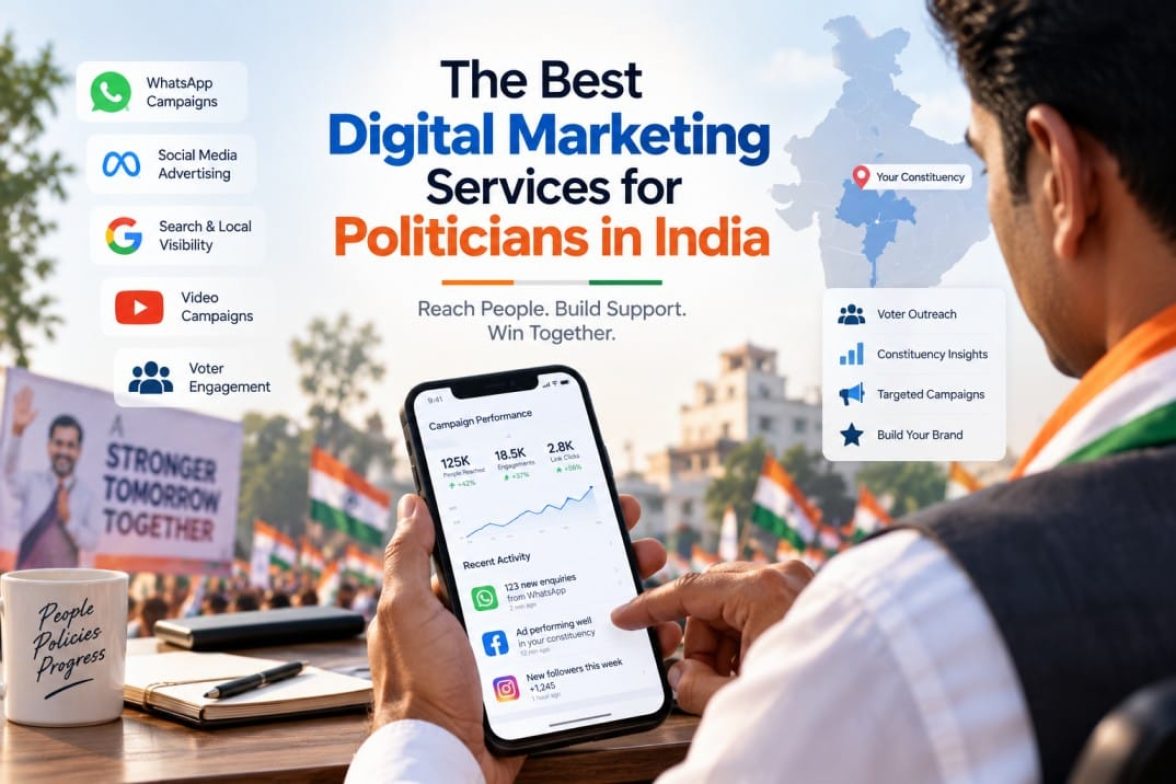
Digital marketing for politicians in India means using WhatsApp, Meta (Facebook and Instagram), YouTube, Google Search and voice or SMS to reach voters, build a leader’s image, and carry a manifesto to the public between and during elections. Whether you are contesting a Gram Panchayat ward or a Lok Sabha seat, it now matters as much as your ground game, because that is where voter attention already lives.
One rule comes before everything else. Since the 2026 election cycle, the Election Commission of India requires every political advertisement, including paid posts on social media, to be pre-certified by the Media Certification and Monitoring Committee (MCMC) before it goes live. Get the strategy and the compliance right together, and digital becomes the cheapest, most measurable route to voters you have.
Quick reference: which channel does what
Short on time? Here is the whole playbook on one line each.
| Channel | Best for | Its real job in a campaign |
|---|---|---|
| Booth-level, direct voter contact | Your highest-trust channel. Small groups and broadcasts by ward and booth. | |
| Meta ads (FB/Insta) | Awareness and micro-targeting | Targets down to a constituency, by age, area and interest. Needs verification. |
| YouTube | Speeches, interviews, storytelling | Your long-form credibility library, plus short reels for young voters. |
| Google Search + GMB | What people see when they search your name | Controls the first impression. Vital for local seats. |
| Voice and bulk SMS | Reminders and mass reach | Turnout nudges and announcements. Counts as an ad, so pre-certify it. |
| Online reputation (ORM) | Protecting the narrative | Runs all year, not just at election time. |
What digital marketing for politicians actually covers
It is not “posting on Facebook now and then”. A serious political digital marketing agency runs one connected system: a personal website and manifesto page, managed handles in the right languages, paid ads, WhatsApp and SMS outreach, video, and reputation management that never sleeps.
The point of all of it is one thing. When a voter, a journalist, or a rival types your name into a phone, they should find a clear, credible story that you control. Between elections that story keeps the connection warm. During elections it turns attention into votes.
Is digital political marketing legal in India? The ECI rules you must know
It is legal, but it is tightly regulated, and this is exactly where first-time candidates trip up. Here is what the current rules ask of you.
- Every political ad needs pre-certification. Nothing goes out on TV, radio, e-papers, public screens, bulk SMS, voice messages, or social media without MCMC approval first.
- Where you apply depends on who you are. Candidates and individuals go to the District MCMC. Recognised parties with a state or UT headquarters go to the State-level MCMC. Submit several days early, because approval is not instant.
- Declare your handles. You must list your authentic official social media accounts in the affidavit you file with your nomination papers.
- Every rupee is on the record. Payments to platforms for ads, content creation, and the cost of running your accounts all count as election expenditure. Under Section 77(1) of the Representation of the People Act, parties file a full internet and social media spend statement within 75 days of the election.
- Uncertified ads are a violation. They are treated as a breach of the Model Code of Conduct. If the MCMC turns something down, a state-level Appellate Committee under the Chief Electoral Officer hears the appeal.
- AI content is being watched closely. The ECI has flagged paid news and AI-generated content for extra scrutiny. Deepfakes and unlabelled synthetic media are a fast way to land in trouble.
The platforms pile on a second layer. Meta and Google both make you verify your identity and location before you can run electoral ads in India, and then they list every one of those ads in a public Ad Library. So assume your opponents can see everything you run, because they can.
A common mistake we see: candidates treat compliance as the boring bit and leave it for later. It is actually the bit that decides whether your ads survive the final week, when they matter most.
The digital channels that actually move votes
WhatsApp: your highest-trust channel
WhatsApp works because it lands in a space voters already treat as personal, right next to messages from family. The trick is not one giant group of five hundred strangers. It is many small groups built around a booth or a ward, each one seeded with a local volunteer who forwards short, relevant updates in the language people there actually speak.
Keep it human and it spreads. A thirty-second voice note from the candidate, a clip from a morning ground visit, or the booth address on polling day will always beat another forwarded poster.
Meta ads: reach and micro-targeting
Facebook and Instagram let you speak to different voters differently. You can run one message to first-time voters in one part of the seat and another to women voters two wards over, at the same time. Reels carry emotion and reach young voters cheaply. Just remember that every paid ad here needs both platform verification and MCMC certification before it runs.
YouTube: the credibility library
YouTube is where the slow, durable trust gets built: full speeches, interviews, road-show recaps, and short documentary pieces on work you have actually done. It doubles as a bank of content that Google surfaces whenever someone researches you. Shoot once, then cut the same footage into reels for Instagram and WhatsApp so one day of filming feeds every channel.
Google Search and Google Business Profile
Type your own name into Google. Whatever shows up first is your introduction to every undecided voter and every reporter. A clean website, some positive coverage, and, for local leaders, a Google Business Profile with your office address and photos put that first impression back in your hands. For Panchayat, Nagar Nigam and Vidhan Sabha seats, where the audience is hyperlocal, this is not optional.
Voice and bulk SMS
Old, but still pulling its weight for mass reminders and turnout, especially in semi-urban and rural seats. Use it for announcements, booth details, and a polling-day nudge. Treat every one of these as an advertisement, because that is what the rules call it, and pre-certify accordingly.
Micro-targeting by constituency and voter segment
Here is the real edge digital has over a hoarding: precision. A hoarding shouts the same line at everyone who drives past. Digital lets you say the right thing to the right pocket of voters, down to a cluster of booths.
Segmentation that works on the ground in Indian seats:
- By geography: the ward, the booth, or a single Assembly segment inside a larger Lok Sabha seat.
- By voter type: first-time voters aged 18 to 22, women voters, senior citizens, migrant workers.
- By language: run the idea in Hindi, and again in the regional language of that pocket. One English campaign across a Tamil or Bengali seat quietly burns your budget.
- By issue: water where water is the worry, jobs where jobs are.
A quick example. A Vidhan Sabha candidate we would advise runs Haryanvi reels of daily village visits for rural booths, Hindi carousel ads on jobs for the town wards, and a women-only WhatsApp broadcast on safety, all inside the same seat, all in the same week. Same candidate, three conversations.
How to run a digital campaign: a realistic timeline
Campaigns that switch on three weeks before polling almost always disappoint, because verification, page history, and reputation all need time to build. This is the sequence that works.
- Six months out: Verify your Meta and Google ad accounts, build the website and manifesto page, set up handles in the right languages, and start reputation work so the story is yours before a rival tries to write it for you.
- Three months out: Get a steady content engine going, videos, reels, posts, and build your WhatsApp lists booth by booth with local volunteers.
- During the Model Code period: Pre-certify every ad through the MCMC before release, then run geo-targeted Meta and Google campaigns segment by segment.
- Final week: Shift everything to getting people to the booth. Voice and SMS reminders, booth-level WhatsApp micro-content, and a clear polling-day plan.
- Poll day and after: Respect the silence period rules, then pull together and file your full digital expenditure statement inside the ECI deadline.
Digital marketing across the election ladder
The right mix is not the same for a ward as it is for a national seat.
- Panchayat and Nagar Nigam: Go hyperlocal. A Google Business Profile, tight WhatsApp groups, and local-language reels beat expensive ad blitzes every time.
- Vidhan Sabha (MLA): Add booth-level WhatsApp at scale, constituency-wide Meta ads, and a proper reputation layer underneath it all.
- Lok Sabha (MP): The full stack, multi-language content, segment-by-segment paid media, YouTube storytelling, and a war-room dashboard someone watches daily.
Common mistakes we see in political campaigns
These are the errors that quietly cost candidates the most, and not one of them is hard to avoid.
- Starting too late. A cold ad account with no history and no verification cannot scale in the last fortnight, no matter the budget.
- Skipping pre-certification. Uncertified ads get pulled, and now you have both an MCC problem and an expenditure headache.
- Buying followers. A booth-level WhatsApp network of 10,000 real voters is worth more than a lakh of fake followers who cannot vote for you.
- One language for a multilingual seat. The message has to speak the pocket’s language, literally, or it does not get heard.
- Waiting for a crisis to do reputation work. If you do not own your search results, an opponent eventually will.
- Boosting posts with nowhere to send people. An ad with no landing page and no way to capture a contact is money set on fire.
What political digital marketing costs in India
The honest answer is that it varies a lot, and anyone who quotes a flat price without knowing your seat is guessing. What actually moves the number is the size of the constituency, how many languages and segments you need, how much video you want, and how long the campaign runs.
Keep two things separate in your budget. First, the agency fee for strategy, content, and management. Second, the ad spend that goes to Meta, Google, and your SMS or voice vendor, which is a pass-through cost you control rupee for rupee. A Panchayat or municipal push can run lean. A Vidhan Sabha or Lok Sabha effort with full-stack content and war-room monitoring sits much higher. Before you sign anything, ask the agency to split those two apart in writing.
Plan your campaign the right way
Holding a compliant, well-targeted digital campaign together while you are also out on the ground is genuinely a lot. That is the part Touchstone Infotech takes off your plate. We build the whole system for candidates and parties, verified ad accounts, MCMC-ready creatives, booth-level WhatsApp, video, and reputation management, and we measure it against votes, not likes.
Want a plan mapped to your seat and your timeline? See our political digital marketing services and ask for a free consultation.
Frequently asked questions
Is digital marketing legal for political campaigns in India?
Yes. It is legal but regulated. Every political advertisement, including paid social media ads, must be pre-certified by the MCMC before release, and all digital spend must be reported as election expenditure to the ECI.
Do I need to pre-certify my social media posts?
Paid political ads must be pre-certified. Regular organic posts from your own declared official handle are not advertisements, but they still fall under the Model Code of Conduct, so the content rules still apply.
How much does political digital marketing cost in India?
It depends on the size of the seat, the number of languages and voter segments, the volume of video, and the campaign length. Keep the agency management fee separate from the ad spend, which is a pass-through cost. A local municipal campaign costs far less than a Lok Sabha effort.
Which platform works best for Indian elections?
WhatsApp for direct, high-trust voter contact, paired with Meta ads for reach and micro-targeting. YouTube builds long-form credibility. The right weighting depends on whether the seat is rural, urban, or mixed.
Can digital marketing reach rural voters?
Yes. Regional-language reels, WhatsApp groups run by local volunteers, YouTube, and geo-targeted ads reach semi-urban and rural voters effectively, often better than generic mass media.
When should a candidate start digital campaigning?
Ideally six months before the election. Ad account verification, page history, and reputation building all take time and cannot be rushed in the final weeks.
Can an agency run political ads on my behalf?
Yes, with the right setup: platform advertiser verification, MCMC pre-certification for each ad, correct disclaimers, and every payment accounted for in your expenditure statement.